The DeFi Stack Is Taking Shape
Lending, trading, stablecoins, and derivatives are converging into a composable financial stack on Ethereum. For the first time, the pieces fit together — and the implications for financial infrastructure are profound.
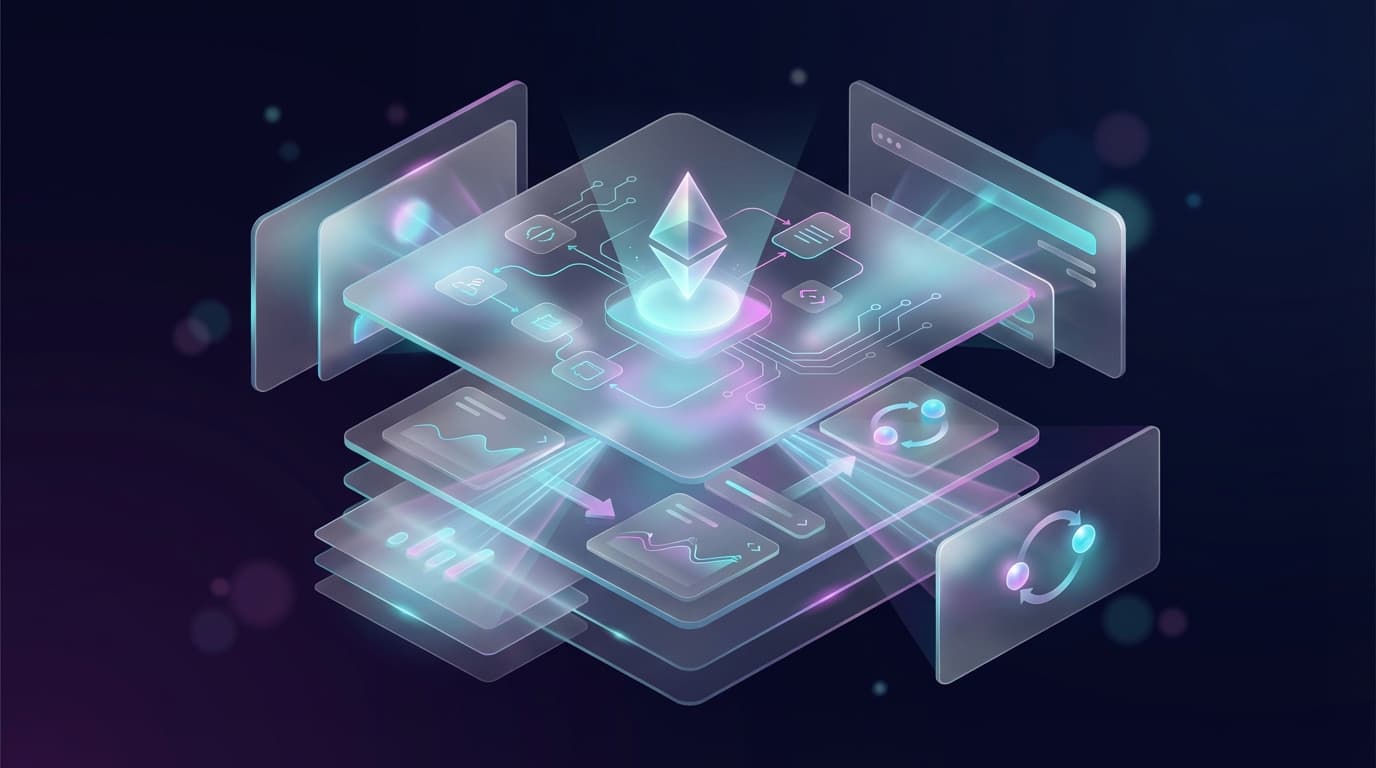
The DeFi Stack Is Taking Shape
Something remarkable is happening on Ethereum, and almost nobody outside the crypto ecosystem is paying attention. A set of independent financial protocols — each solving a specific problem — are beginning to compose into something that looks like a coherent financial stack. Not a single application. Not a platform controlled by one company. A stack of open, permissionless financial primitives that anyone can build on, combine, and extend.
MakerDAO provides the stable unit of account — Dai, a decentralised stablecoin that has maintained its peg through an 85% market drawdown. Compound provides lending and borrowing — algorithmically determined interest rates for supplying and borrowing crypto assets, with no intermediary, no credit check, and no minimum balance. Uniswap provides exchange — an automated market maker that allows anyone to trade tokens without an order book, a matching engine, or a centralised exchange. And dYdX is building margin trading and derivatives on top of these primitives.
Each of these protocols is useful in isolation. Together, they are something more: the early architecture of a financial system that operates entirely on code.
Why Composability Changes Everything
The most important property of the emerging DeFi stack is composability — the ability to combine protocols like building blocks, without permission from anyone. A developer can build an application that borrows Dai from Compound, trades it on Uniswap, and uses the proceeds as collateral in another protocol — all in a single transaction, all without any of the protocol teams having a business relationship or even knowing each other.
This is fundamentally different from how traditional financial products are built. In traditional finance, combining two products requires legal agreements, API integrations, compliance reviews, and months of negotiation. In DeFi, composability is native — every protocol is an open API that any other protocol can call. The result is a development velocity that traditional finance cannot match. New financial products can be prototyped, tested, and deployed in days rather than months.
The risk, of course, is that composability also compounds vulnerabilities. A bug in one protocol can cascade through every protocol that depends on it. A failure in MakerDAO's oracle system could affect every protocol that uses Dai. The interconnectedness that makes DeFi powerful also makes it fragile. But that is a solvable engineering problem, not a fundamental limitation.
What Is Still Missing
The DeFi stack in early 2019 is impressive but incomplete. It lacks robust insurance mechanisms — there is no way to hedge against smart contract risk or oracle failure. It lacks identity and credit — every interaction is over-collateralised because there is no on-chain reputation or credit scoring. It lacks privacy — every transaction is visible on the public blockchain, which is unacceptable for many financial use cases. And it lacks the user experience that would make it accessible to anyone outside the crypto-native community.
These gaps will be filled. Insurance protocols are being designed. Identity solutions are being explored. Privacy technologies like zk-SNARKs are advancing. And user experience will improve as the underlying infrastructure matures. But the gaps are real, and they define the work that needs to happen before DeFi can serve a broader audience.
My View
The DeFi stack taking shape on Ethereum is the most important development in crypto since Bitcoin itself. Not because it is ready for mainstream adoption — it is not. But because it demonstrates, for the first time, that a complete financial system can be built on open, permissionless infrastructure. The primitives exist. The composability works. The question is no longer whether decentralised finance is possible. It is how long it takes to mature.
The DeFi stack is not a product. It is an architecture — a new way of building financial systems from open primitives rather than closed platforms. The architecture is taking shape. The products will follow.